
Travel efficiency is no longer defined solely by speed or destination—it is increasingly shaped by how effortlessly travelers move through complex environments such as airports, train stations, and urban transit hubs. Against this backdrop, the Self-Propelled Suitcase has emerged as a transformative travel innovation, integrating robotics, intelligent control systems, and ergonomic design into a single mobility solution.
Rather than forcing users to drag or push heavy luggage, a self-propelled suitcase actively assists movement, reducing physical strain while improving navigation efficiency. Companies like SYEV are at the forefront of this shift, developing intelligent luggage systems that align with the evolving expectations of business travelers, digital nomads, and mobility-conscious consumers.
What Is a Self-Propelled Suitcase
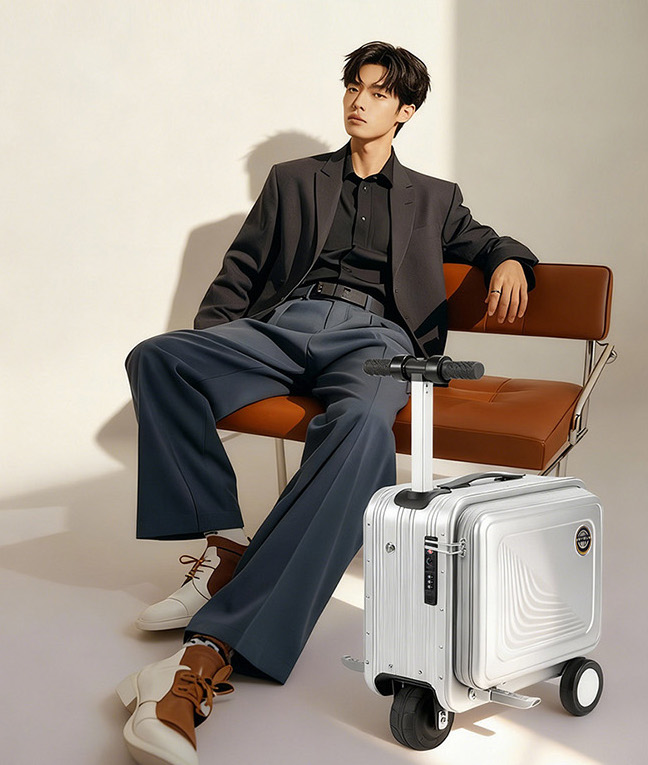
A Self-Propelled Suitcase is a motor-assisted piece of luggage equipped with integrated drive units, sensors, and control algorithms that enable it to move autonomously or semi-autonomously alongside the user.
Unlike conventional smart luggage that focuses on tracking or charging capabilities, self-propelled suitcases prioritize physical mobility assistance, allowing the suitcase to:
Follow the user at a controlled speed
Maintain balance under dynamic load conditions
Adapt to different walking paces and surface conditions
This evolution represents a convergence of consumer electronics, robotics, and travel gear engineering.
Core Technologies Behind Self-Propelled Suitcases
Electric Drive and Power Management
At the heart of a self-propelled suitcase is a compact electric drive system, typically consisting of:
High-efficiency hub motors
Rechargeable lithium battery modules
Intelligent power distribution units
Advanced energy management ensures sufficient runtime for long airport transits without compromising weight or safety. SYEV designs emphasize optimized torque-to-weight ratios to deliver smooth propulsion without abrupt acceleration.
Sensor Fusion and Motion Control
Self-propelled mobility depends on precise environmental awareness. Modern systems integrate:
Gyroscopic sensors for balance control
Proximity sensors for obstacle detection
Speed and direction sensors for synchronized movement
Through sensor fusion algorithms, the suitcase can maintain alignment with the user while avoiding collisions in crowded spaces.
Human–Machine Interaction
User control remains intuitive and unobtrusive. Common interaction methods include:
Handle-based force sensors
App-based speed and mode selection
Emergency manual override systems
This ensures that assistance enhances mobility without reducing user control—a critical factor in crowded or regulated environments.
Practical Advantages for Real-World Travel
Reduced Physical Fatigue
Dragging luggage across long terminals or uneven surfaces places repetitive stress on the wrist, shoulder, and lower back. A self-propelled suitcase absorbs much of this load, allowing travelers to conserve energy, especially during multi-leg journeys.
Improved Maneuverability in High-Traffic Areas
Self-propelled systems are designed to maintain stable trajectories, even during sudden stops or direction changes. This is particularly valuable in:
Airport security queues
Railway platforms
Urban pedestrian corridors
By maintaining controlled motion, users experience fewer disruptions and smoother transit.
Enhanced Accessibility
For elderly travelers or users with limited mobility, self-propelled suitcases provide meaningful assistance without requiring additional mobility devices. This positions the product not merely as a luxury item, but as an inclusive travel solution.
Safety, Compliance, and Airline Considerations
A critical design requirement for any Self-Propelled Suitcase is regulatory compliance. Key considerations include:
Removable battery systems meeting airline carry-on regulations
Fire-resistant battery enclosures
Fail-safe braking and power cut-off mechanisms
SYEV integrates compliance-aware engineering to ensure that propulsion features do not conflict with aviation safety standards or public transport regulations.
Conclusion: From Carrying Weight to Sharing It
The Self-Propelled Suitcase reflects a fundamental rethinking of how luggage interacts with its user. By shifting from passive storage to active assistance, it addresses real physical challenges faced by modern travelers.
Through intelligent engineering, safety-focused design, and user-centered functionality, solutions developed by SYEV demonstrate how mobility technology can meaningfully enhance the travel experience—without compromising control, compliance, or durability.
https://www.syevglobal.com/travel-without-drag-engineering-the-self-propelled-suitcase.html